Monday, October 01, 2018

Memories of Roy Jones #4


Mr. Hoke McDaniel was one of the best comedians that I have ever been acquainted with.   He made the depression a little easier to live through.  He lived about a mile from Reynolds in a house painted red on good land.  He was an automobile mechanic by trade.  He looked that part.   He really didn't look like anybody except Hoke McDaniel.

 He died in the Reynolds hospital   The day before he died Dr. Sams was making the rounds.  Hoke asked him if he had brought the asbestos soup – I’m going to need it for where I’m going.   He had a bunch of children but I never heard of any trouble from them.   I suspect he was a poor provider because he was always joking.

When I was in school he would come to the stage once a year dressed in all kinds of clothes – mismatched and in black face.  He would imitate the black preachers and give a sermon.  He told of a revival he had conducted a week or two before.   As the congregation got worked up, he had gotten himself worked up.  He took off his coat and laid it on – he pulled off his tie, he pulled off his shirt and kept preaching.   He reached down and got to his underwear and then said “That’s when I come unto myself.”

This is a classic story and it sounds like him.  He sat around in the drug store where the men would visit.   It was during a gubernatorial election and Mr. Charlie Neisler, who owned the bank and automobile place, was the most influential man in the county.   He had served as a State Representative before then.  Governor Tuby Hardman came to town and Mr. Neisler was escorting him around Reynolds and stopped at the drug store.  Hoke jumped up and met him.   He was excited and told the governor that it had been a long time – he thought they wouldn’t ever run into each other again.   The Governor was a good politician and didn’t act surprised even though he had never seen Hoke before in his life.  He went along and said it had been a real long time.   Hoke asked him “What have you been doing since we were together.   The Governor replied that he had been a doctor for 30 or 40 years.   He asked Hoke “What about you?”  Hoke replied that he had straightened up too – came on home.   Hoke then asked the Governor “Wasn’t that Birmingham jail on of the deadest places you have ever been in?”  Mr. Neisler was furious and blessed out Hoke.   But that wasn’t going to stop him.    

Right across the street from the drug store was the Reynolds Banking Company.  The bank was one of the easiest businesses to get closed up during the depression.  You could go in the morning the door will be locked.   A note would say “This bank is closed under regulations of so and so.”  Everyone would read the note on the door and check the handle to the door.

Mr. Luke Mitchell lived a mile out of Reynolds in a two story house.  He had a terrible affliction.  His legs would go before his chest and head.  He tried to hide it – he could walk without a walking stick but he usually would carry one in each hand.   He walked up to the bank to read the sign.   The people from the drug store would watch everyone read the notes.  A salesman was in the drug store at that time.  Hoke told the salesman that the man reading the note was Mr. Mitchell and was one of the biggest depositors in the bank.   He’s soiling his pants right now.  The salesman watched Mr. Mitchell and said “Doggone if he didn’t -- I can’t wait until I can tell what I saw in Reynolds!”

Hoke would pick up hitchhikers and say let’s get a bite to eat.   They would eat and Hoke would tell them that he was in a bit of a hurry but he would pay as he left so that they could stay as long as they needed.  The hitchhikers would tell the cashier that their dinner had been paid for.  She would say that no, Hoke said that you were going to pay for it.

 There are hundreds of stories about Mr. Hoke and sometimes the joke was pulled on him.   Once he was underneath a car he was working on.  A salesman came in and asked for Mr. Hoke.  A man said that he’s there under the car but you better talk as loud as you can so he can hear you.   The salesman thought Mr. Hoke was hard of hearing.  He screamed at him as he rolled out from under the car.  Mr. Hoke talked loudly right back.   The conversation continued until one of them finally figured that neither one of them was deaf.

Mr. Hoke went to extremes having fun with other people.   Once he mounted lights on the back of his car.   His plan was that when he passed a car – we only had dirt roads back then – he would turn on the lights on the back of the car and the people would think they were meeting a car.  He tried it out on Blackman curve – a curvy road that used to be six miles below Reynolds.   The people back of him took off through the woods and had a wreck.   He didn’t try that trick any more.

 Harry Powell ran the meat market/cafe/hamburger stand.   He would stand next to the window on the left where he cooked the hamburgers and to the right was the meat market.   In the back were the tables where he served meals.  You didn’t order – you would be served what he had.   It was one meal for everybody and he called it a sawmill dinner.   They were good except you were served twice of what you could eat.   Mr. Hoke called it a full house. 

 They were all eating dinner when Mr. Hoke opened the screen door in the front and held up a dead dog.  He said loudly “Harry this one is bigger than yesterday – what would you give me for him?”  Hash was being served for dinner and it was said most everybody put their silverware down and marched out.

 Mr. Hoke lived near the veterinarian, Mr. Clifford Whatley.   Why Mr. Clifford would haul Mr. Hoke around with him. I don’t know why but Mr. Hoke went with him a heap of times.   I called the vet one night for a sick mule.   That’s the worst feeling in the world.  It was always costly to replace a mule when there wasn’t any money but it was especially hard in the middle of crop season.  Mr. Hoke knew I was worried to death about my mule and called me over.    I asked him if he thought my mule was going to live and be all right.   He said, “Let me put it this way – every tool that Dr. Whatley uses is made by Winchester.”   He wasn’t very soothing.


… to be continued.
Recordings of Roy Jones.  Transcribed by his daughter, Harriet Jones Geesey.

Friday, September 28, 2018

Memories of Roy Jones #3


I told you a little bit about the town itself.  The town couldn’t survive if it wasn’t for the farmers. The land around Reynolds is above average – some is as good as any in the country.  The Crowell community north of Reynolds about seven or eight miles is where the old Indian reservation was the last to leave.  That land lines runs northeast to southeast. I don’t know how that came about but most of the farmers had about 100 acres of land. Economically they were about the same.  It made for a good community – each one tried to outdo the other.  The land was so good there that it could support the families.  One of the oldest churches is the Crowell Methodist Church.
The average farm would run about 200 acres. A farm without woods was not considered desirable because we used woods for everything.  If you didn’t have woods on your farm it was considered to be a bad thing. Most were worked by two mules – that’s all we had to plow with.  Each mule could work about 30 or 40 acres, which meant you had 80 acres a man.

Cotton was the only thing you could sell in those days.  A few families were big enough to work the land themselves.  The others were done by sharecroppers.  Each farm would have about two tenant houses. You wouldn’t call them shacks.  With a lot of them you were not much worse off than the farm owners. We didn’t have anything to preserve the wood with. Our house was always screened but the screen was so coarse it would let the mosquitoes through it.  The tenant house usually had wood shutters.  When those shutters where closed you lived in darkness.

We didn’t have electricity back then.  We had lamps – rail lamps.  It had shiny brass that would reflect the light better.  A lot used glass lamps.  Most of the water came from open wells.  Since the mules used more water than the people, the wells were generally located as close to the mule lot so that you could just pour water over the fence to the mules.  I’m sure today it would not pass any type of qualifications. There is an art to drawing well water – most had a pulley with a rope or chain that went through the pulley.   There would be a tin bucket on each end. You let the bucket down and fill it with water. As you pulled it up the empty bucket would be going down.   When that bucket would hit the water it would lie on its side.  You had to have the right twitch or else the bucket would jump up and down.  The people that used the wells a lot knew exactly how to pull and to let the top of the bucket go under the water just a little bit – then the bucket would go on and sink.

There were a few exceptions to the small farms.  One was the large plantation that had 18 or 20 mules and six or eight tenant houses.  They could always get sharecroppers because back then people liked to live close together.  The sharecropper would furnish the labor of planting the crops.  The owner would buy the fertilizer and seed.  The sharecropper would pay the owner back with half of his crops.  It came in bad repute but it worked pretty good because it gave a man the incentive to work when all he had to give was labor.  If there wasn’t any trouble by the fall, they would want to sharecrop with you the next year.   I guess some owners would want to cheat them out but most times they were making money for the owner because things were so cheap, particularly in the depression.   Most played fair and square.  Of course, if the sharecropper didn’t like it, he could move off and get another place.  Some liked to move but most stayed in the same place for years.
My daddy had the best reputation as anybody in the world.  I never ever heard him say as much as doggone. He was a mail carrier and started carrying the mail in about 1900.   He carried it in a buggy, then a motorcycle, then in a car.  When he died, I think he was using a 1931 or 1932 model Chevrolet. It’s nothing compared to what we have today.  Back then the mail man just went down the main road and the people who lived off from it would put up boxes.  In a lot of places they would have them mounted on wagon wheels.  The mailman would turn the wheels to get to the six or eight boxes.

A lot of advertising was done by giving out samples in those days.  We didn’t have the media like radio or TV or even newspaper.  Samples from companies were just put in all the mailboxes.  One time I remember – I believe it was Feenamint or Ex-Lax causing trouble.  The samples had been put in all the boxes. Children would get the mail and some thought they were candy or chewing gum.  It was a real problem, especially when there were multiple boxes.  But that’s the way they advertised.

… to be continued.

 Recordings from Roy Jones.  Transcribed by his daughter, Harriet Jones Geesey.

Tuesday, September 25, 2018

Memories of Roy Jones #2


Reynolds High School
About two blocks from the business section was our school.  Reynolds High School. It was an impressive, big building with two stories.  It was used for 6th, 7th and 8th grades after they combined the high school with the one in Butler in the 1960’s.  It has since been torn down.

Now Butler is nine miles west of Reynolds.  Of course there was a dirt road to it.  It is the county seat of the county.  There was always a lot of jealousy between Reynolds and Butler.  Being the county seat, Butler had a few more people – they naturally get more than Reynolds and Reynolds was always jealous of that.  We fought for years to keep our schools running.  It was not unusual for the graduating classes to have 12 or 15 students.   When I graduated in 1923, I think we had 21 or 22.  They bragged about how big the class was.  They kept the school because they knew it would be the center of the community.  After the high school left, all we had were the churches to hold the community together.  That’s really what has happened since the schools combined in the 1960’s.

There were a few old homes but not many that I know of that were built before the Civil War.  I always say the Woman’s Clubhouse was the oldest home in Reynolds.  There were a lot of nice homes like the Papphousing house that was built right across the street from the Clubhouse. There are several scattered around the town.  Back then most houses were built as close to the business block that you can get.  I guess that would be natural because to be away from town meant that you would have to walk or go in a buggy.  Reynolds was so isolated that it developed its own culture.  Fort Valley is 15 miles to the east but you would have to cross the Flint River and swamp.  To get to Fort Valley, you would have to drive to Roberta about 14 miles north but you would have to cross a river to get to Roberta.   To go to Macon you would go through Roberta.  Mr. Neisler, a prominent businessman, built a private bridge across the river and would charge 50 cents to cross.  When you came back, you would have to pay another 50 cents.

Montezuma and Oglethorpe were about 20 and 22 miles south of Reynolds but to get there was all dirt roads.  So that left only Butler - which was a good drive for a horse to make it there and back in a day’s time.  The best way to get out of Reynolds was the trains.  There were four trains that came to Reynolds.  Two came early, one going toward Columbus and about 30 minutes lataer the one from Columbus to Macon would come through.  That would be repeated at about 2:00 or 3:00 in the afternoon.

As I mentioned, we had developed a good culture within our town.  Mr. Joiner, the school principal for 50 years, was one of the reasons for that.  He came from Kentucky and many of us owe a lot to him. He believed in the old way – he taught in the classroom but would occasionally walk the hallways.  Any student having to wait in the halls when Mr. Joiner walked by would get the beating of his life.  He had a janitor named Uncle Henry.  Every Monday morning Uncle Henry would go across the patch of woods and come back with an armful of switches.  I don’t know how Mr. Joiner got to the switches so quick. The worst feeling in the world was when the teacher sent you to stand in the hall.  Every door that cracked you would think Mr. Joiner was coming.  You had about a 5% to 10% chance of him coming because he was teaching.  But if he did come there was a 100% chance you would get the beating of your life.  We would be sitting in the classrooms and would hear the licks out in the hall.  There is a certain amount of sadism in all of us – some would whisper, “Pour in on Mr. Joiner, pour it on!”  We wouldn’t know who was getting the whipping.  My wife had taught in three other schools. She said at the other schools, over 50% of the time spent in faculty meetings were covering disciplinary problems.  She was surprised that in Reynolds, discipline never came up in a single meeting.

We didn’t run out when it was time for lunch.  Mr. Joiner had his own rules.  He stood in the middle of the hall and we would march out by the drum beat.  If it wasn’t raining, we would sit on the steps on the south side of the building and eat lunch.  If it was raining, we would eat in our classroom.  The town people went home for lunch.  Most of us had light bread – you couldn’t buy it sliced back then.  It was the worst job in the world to cut soft bread – the slices wouldn’t be the same width.  The majority would bring a biscuit and meat or biscuit and peanut butter.  Some of the sacks would be greasy because they would bring side meat of fatback for their lunch.

I’m getting off the subject but I do remember in the third or fourth grade our teacher said a student needed to be isolated.  She said she wasn’t going to name him but for all the boys to take a good bath and the best soap to use was Lifebuoy.  We didn’t know what isolated meant.  Some that lived in town said they would look in the dictionary when they went home for lunch.  They came back and told us what it meant.  The funny thing is that it was a good percent of the girls and boys were from the country and I don’t remember being bothered by body odor the whole time I was in school.  I can name more people now that have body odor than did back then when we didn’t have indoor bathrooms.

I also remember in the third grade when the teacher said there would never be another war. I remember feeling that I was born at the wrong time because there wouldn’t be any excitement.  Our teacher had said the war to end all wars had been fought.  She called in the World War.  No one dreamed there would be World War II.

All of my children took music from Mrs. Pendergrast, who taught for many years. She was a good teacher – one of the best.  The extent of our culture is shown in the fact that her son, John Pendergrast, sang opera in New York for years.  I remember him coming to the chapels in the auditorium.  He could hold a note for so long that some of the students were snickering.  When we got back to our rooms the teacher was not too pleased.  We all blamed it on the Potterville boys but I suspect that it was some of us too.  We had never heard anyone hold a note so long.

We also had the Newsome family orchestra that, to me, was as good as any big name orchestras. I think they could have competed with Glen Miller or any of them.  It wasn’t composed completely of Reynolds people.  It included little Fred Peed and Doc Tante from Butler that I remember.  They played for dances all around and could play any kind of music you wanted.

The black community had their own way to show off their musical talent.  Southwest of Reynolds there were a lot of farm owners that were black.  Every Saturday, when a lot of blacks were in town, an orchestra would come to town. The band was led by a man named Johnny Salem and was much like the Florida A&M band.  He would go through all kinds of gyrations in front of the band with his stick. All of them would cut up and sound in rhythm.  In the back were little boys. All they would have were tubs and pans and sticks of wood but they had a perfect rhythm.  I used to beg Daddy to take me to town on Saturday afternoon and hoped to see them.  The streets would be filled and all of a sudden someone would holler, “Johnny Salem and his band are coming to town!”  You could hear them in the distance.  It sounded like thunder to start with from the west side.  They would come up the main street and go to the railroad, whirl around, and go to the other section of town.  Everybody would park and watch them.

There were other cultural events like spelling bees.  What always fascinated me was that not always the smartest person was the best speller.  The spelling bees involved all the towns around and we took a lot of pride in them.  Jim Brewer, who had one of the barber shops, was a good speller and was captain of the Crowell team.  Mr. Joiner was giving out the words.  The first word the Crowell team had to spell was “habit.”  You would spell by syllables.  The first Crowell participant said “ h a b hab, i t it.  The next word to Mr. Jim was rabbit.  He said, “r a b rab i t it.   It was hard for him to live down that he was the captain of the team and wasn’t able to spell rabbit.

---to be continued.

Recordings from Roy Jones.  Transcribed by his daughter, Harriet Jones Geesey.

Monday, September 24, 2018

Memories of Roy Jones #1


I’m Roy Jones. I’m recording this on September 28, 1995.  The purpose is to have some record of the changes that I have seen in my lifetime in our living styles.  I have really lived in two worlds – the world before World War II and the world after.  I often think how interesting it would have been if some of the family members had left some type of autobiography to show how they lived. The family tree is good but it is pretty dull.  The real stories are in the life they lived.

As a preface, I was born at the right time in history and in the right place.  I have seen so many changes and inventions – many of them coming after the age 21.  I am now 79.  I married the best wife in the world and I don’t think I could’ve married a better woman who could have suited me as Ruth has.  I have wonderful children – every one.  I think if I had to pick when and where I was born, I would pick the same. I had the best neighbors, best friends, the best co-workers – even casual acquaintances through my work.  All of this adds up to what I think is a very happy life.

I was blessed to live in the period I lived in and witnessed the many changes in a community like Reynolds and Taylor County.  My daddy’s folks always lived in Reynolds and my mama’s people lived near Butler, so this has always been my home.  There were wonderful stories told.  These stories were told thousands of times because it was before we had radio and TV.

First, a description of Reynolds. This is during my early childhood during the 1920’s.  Most of the buildings were two-story, brick buildings built all close together without a firewall or anything between them.  This proved to be a bad thing later on.  On the west side of the block of buildings was a tin shelter that extended all over the sidewalk.  It must’ve been 100 to 150 feet long.  That’s for people to get under when the weather got bad.

Reynolds Baptist Church
Saturday was the big day.  All of the black people came to town on that day from the farms and they just crowded the sidewalks.  An unusual thing across the south side was a park that I believe was donated by Mr. Coleman, one of the first settlers of the area, that comprised of must be four acres of land.  He gave it to be used as a park and for the establishment of churches.   On the southwest side of the park was a Baptist church.  At that time it was a nice, white wooden church. On the northeast corner of the park was the Methodist church.  It was and is an impressive building that was built right after World War II. In the center was a bandstand.  On Sunday afternoon the local performers would get up and give a concert.  It was torn down, much to my chagrin, because I thought it made a perfect setting for a park.

All streets and sidewalks were dirt.  All of the stores, or most of them, were in the bottom of the two story buildings. Upstairs housed the dentist and lawyers offices.  Right in the middle of the block was a hotel called the Big Oak Hotel. There used to be a big oak that stood by the sidewalk right in front of it and it had a balcony extended over the sidewalk.  I was always sorry that I didn’t ever go up there and watch the people but I never did.

The telephone office was also located on the second floor of a building about center on the west side of the business block.  The funny thing was that we always had a telephone extended out in the country and there were always jokes about the party lines.  I think we paid two dollars a month and we had five parties on our line.  When you rang the operator, we called her Central you would tell her who you wanted, not the number.  We did have a phone book but nobody went to the trouble of looking up the number.  A lot of times she could look out the window and see the person you were calling on the sidewalk.  She would call them and get them into the drug store to talk to you.  At one time we had three or four doctors.  Most of them were located in the back of the drug store, which made it convenient.

Most things were bought on credit.  The farmers depended on cotton and sold it once a year.  They had no income except that one day when they would sell their cotton.   One story that shows the extent of credit, that may be true and may not be true, involves the Barrow Brothers.  They operated a hardware store.  There were not such things as fresh vegetables to sell, but each store would sell cheese, crackers, flourpoints and small tools. The Barrow Brothers operated in a two story building on the southwest corner of the business block. One of them one day told the other that he had sold a saddle but couldn’t; remember who he had sold it to and couldn’t find a record of having charged it.  They thought of it a long time and decided to put “one saddle” on the top of each of the statements.  When the farmers came in to pay their statement in the fall, the one who didn’t object would be the one who had bought the saddle.  In the fall when the farmers paid up, nobody objected.  Every one of them paid the cost of the saddle.

Across the street from the Barrows was also a two story building that sold everything.  It sold clothes in addition to groceries.  In the back of Goddard’s store was his undertaking establishment.  Later on you could buy your baby food in the front and have your funeral in the back.  They eventually moved out and built a nice funeral home.

One of the first businesses was the Ford Dealer, Mr. Crawford.  He couldn’t read or write but was still a good businessman.  The story is that Clyde Hill, the druggist, went to try a new car.  Mr. Hill was a type of “desperado” when it came to driving.  They went across the railroad tracks and Mr. Hill started going too fast.  Mr. Crawford reached down to the floorboard and got the instructions.  He said, “This instruction book says here you have to stay between the ditches.”

The gins were dependent on cotton.  At that time we had two gins that were located not over two blocks from the business section.   We had an ice house located in one of the gins. The only time we could get ice was on Friday when they would bring it from Macon.  The jail stood right across the railroad that bisects the town going east and west.  The jail couldn’t have been over 12 or 15 feet square and stood out in the hot sun, 75 or 80 feet from any building or shade tree.  I think it had one window at the top and it had a heavy door with a chain through it.  I would be an awful place to be – hot or cold weather.

I mentioned we had three or four doctors.  Medicine back then was pretty primitive. This is a story told about Tom Sanders.  Mr. Sanders was 28 years old and became constipated.  He had never been to a doctor.  He went to Dr. Mangham and told him the problem.  Back then all they knew to do was to give an enema. Dr. Mangham told him to lie on the table on his stomach.  As the doctor began his procedure, Tom Sanders jumped up and yelled, “Be careful there doc – you almost stuck something up my ass!”

You develop a town like Reynolds in strange patterns.  About a block from the main section was a big storm pit.  I guess it was contagious but a lot of people would head to the storm pit when a cloud came up or looked anyway threatening.   One Sunday afternoon we went for a ride and there had been a shower about thirty minutes before.  We came by the storm pit and they were marching out and all were looking around to see where it was.  It had been gone for 30 minutes or more.

The stores sold most of the same thing except we had two or three meat markets.  They didn’t have deliveries like they do now.  The manager of the meat market would find cows and butcher them and bring them and sell them during the weekend.  It was anything but sanitary or humane.  We had a few cows, mostly dairy cows.  Daddy sold one grown cow and the meat market manager came out to kill the cow.  Daddy was gone.  The man came to the door to see if we had a shotgun because they were having trouble killing the cow.  That’s about as bad as you can get.  But we only had meat on the weekend.  There was no such thing as fresh vegetables, so the big seller was cheese.

Across the railroad track was the black section.  We called it the bottom.  Most of the houses were similar that have two or three rooms.  Everything was built out of wood.  There were three brick homes in Reynolds. One owned by Dr. Bryan, the other was owned by Charlie Neisler, who owned the gin and warehouse where they stored the cotton.  The third one was built out of some kind of stone by Mr. Ricks, who also operated and gin and warehouse.  Most of them that operated a gin and warehouse were considered the top men in a town like Reynolds.

The other houses were built out of wood. Most were painted and looked attractive.  Of course, at that time we didn’t have modern grass for lawns – there wasn’t any way to cut it.  So we swept the yards once a week on a Friday afternoon.  There is really nothing prettier to see a yard has clean as it can be and showing the print of the broom.  The broom came from sassafras bushes that had a lot of branches at the top and made perfect broom.  Some of them used cane brooms but that was a slow and tedious process.

A lot of people within a block of the business section had milk cows.  I particularly remember Mr. Flowers that taught school.  He lived in what is now the Crawley house.  On a Halloween he had gone off and somebody got his milk cow.  He hunted for him the whole weekend but couldn’t find him.  On Monday when they opened the school, they found the milk cow upstairs in Mr. Flower’s classroom. Mr. Flowers was old and they liked to play jokes on him.  How they got the cow upstairs and how they got the cow down, I don’t know.

 …. to be continued.

 1995-1996 recordings from Roy Jones.  Transcribed by his daughter, Harriet Jones Geesey.

Saturday, September 22, 2018

People of Taylor County

There were wonderful stories told thousands of times.  Before we had radio and TV, people were closer together and had more conversations and lots of stories were told.


One of these stories involves Judge Aultman and Mr. Paris.  Down Railroad Street right at the east side of the business block facing the railroad was the Paris House. It was across from Rick’s gin where they’re building a tourist place now.  It was a hotel built in a long L shape and it had a porch.  And the boards went up and down like you see chicken houses built sometimes.  It was protected from the weather because the porch went all the way around.  Every room opened on the porch and I guess there were chairs by every room.   But that’s where most of the traveling salesman would stay.  They would have a standing reservation.  They would work the stores and then go there and sleep.  One of them was Jewish and would fuss about everything.  Nothing suited him.

Judge Aultman was Bobby Aultman’s grandfather and a Justice of the Peace.  When I started school I know he was the mayor.  At the start of school Mr. Joiner got everybody in the auditorium and Judge Aultman welcomed us to Reynolds.  Most of the students came from the country.   I thought Judge Aultman would always be the mayor and I guess he might’ve been.  The only thing I remember people saying about him – and I don’t know if it was a criticism or compliment – was that if there was a sideshow in the United States, he was going to get it for Reynolds.   Back then we didn’t have much entertainment and we had all kinds of shows. Sometimes it wouldn’t be anything but a man and a monkey.
Anyway, Judge Aultman and Mr. Paris were the best of friends.  I don’t know which one thought it up, but they decided to pull a prank on the salesman.  They decided since he’s always fussing and nothing suits him, they would give him something to fuss about.  There weren’t any bathroom waterworks back then, so each room had a slop jar.  I think they’ve been used since the beginning of time. They filled a jar with home brew – and I think they put some crackers in it too – and put it under the bed in the man’s room.

They knew it was the day he was coming and they sat on the porch and waited for his arrival.  Sure enough he went to his room and he came storming out.  He was upset and said that this place is not fit for a pig to live in. They asked what was the matter.  He replied that for one thing the slop jar hasn’t been emptied for days.  They jumped up and Judge Aultman said, “Paris, let’s show him just how nice and clean a place you run!”  They went to the room and he followed them.  Mr. Paris reached under the bed and got the slop jar and started drinking it.  The man started jumping up and down and said, “Stop it gentlemen, stop it!!”  But they passed it to each other.   They said it was mighty good and they paused.  The man said that had he known they were going to drink it, he wouldn’t have used it.

Recorded by Roy Jones circa 1995

Friday, December 29, 2017

Appreciating the Trials

One of the greatest lessons I have learned in life has to do when things do not go my way.  Not only have I learned the importance of enduring the trial but maybe I am finally learning to appreciate it.  God has always had a way of taking what we believe is bad and turning it into something good – even better than we ever imagined.   I think we tend to get bogged down in the details while God is orchestrating our lives from a completely different vantage point and maybe even a different purpose.

Edward A. Goddard
We can see this incredible picture more clearly when we look back. Sometimes we may have to look back further than we think.  I learned recently that maybe the biggest trial of my life came about eighty nine years before I was born.  April 20, 1865 to be exact and it was the day Macon Georgia fell into Union hands and about 11 days after General Robert E. Lee surrendered to General Ulysses S. Grant at Appomattox.

My great grandfather, Edward Aldrich Goddard, was in Macon that day among those Confederate troops.  I’m quite certain that was a difficult day for my 23 year old future great grandfather.  In fact, I would venture to say it was the worst day of his life.  For almost four years, he had fought for the Confederacy.  The fact that he had lived most of his life north of the Mason Dixon in Ohio with his grandparents and then later in Massachusetts had to weigh on his mind.   Not sure if you have read about what it was like to fight in the Civil War but if not, you should do it sometimes.  It had to be over the top crazy difficult.  Here is a little snapshot:

The life of a soldier during the civil war wasn't easy. Not only did soldiers face the possibility of getting killed in battle, their daily lives were full of hardships. They had to deal with hunger, bad weather, poor clothing, and even boredom between battles. The soldiers of the civil war had to deal with terrible medical conditions. Doctors didn't know about infections. They didn't even bother to wash their hands! Many soldiers died from infections and disease. Even a small wound could end up infected and cause a soldier to die. The soldiers of the Civil War were often hungry. They mostly ate hard crackers made from flour, water, and salt called hardtack. Sometimes they would get salt pork or corn meal to eat. To supplement their meals, soldiers would forage from the land around them. They would hunt game and collect fruits, berries, and nuts whenever they could. By the end of the war, many soldiers in the Confederate army were on the verge of starvation.  From American Civil War - Life as a Soldier in the Civil War.

Ed Goddard enlisted in the Confederate Army in Arkansas where he would join Company H of the Sixth Arkansas Infantry Regiment.  After he finished school, Ed had moved from Massachusetts to Arkansas to work for his older brother.  Incredibly he would spend the next almost four years of his life as an infantryman camping in all kinds of horrific conditions, hiking no telling how many miles, fighting many battles and losing many of his friends and comrades along the way.  For you Civil War buffs - and to make a point, he fought in the Battle of Shiloh, Perryville, Murfreesboro, Chickamauga, Missionary Ridge, Ringgold Gap and was on the Sherman and Johnson Campaign from Dallas to Atlanta. He also participated in several days of fighting around Atlanta before the war ended.   Somehow Ed found himself in Macon and was with the troops when they were forced to give up when the City of Macon surrendered to the Union forces in 1865. 

I cannot even begin to imagine what he and all the others went through in that war – on both sides.   The fact that Ed Goddard eventually ended up in Macon was not an accident though. It was part of the plan.  Not the plan young Ed could see at the time, but the one God was orchestrating from that different vantage point.  I am fairly confident when Ed signed on to join the confederacy, he had no idea he would end up in Macon Georgia.  In fact I am very confident he had no way of knowing that.

To understand the bigger plan, there is more to the story.

Ed’s father, James, was one of the early settlers of Macon.  James and his younger brother Bailey moved from Athol MA to Macon GA in the early 1820’s, well before any hint of a Civil War. James (Captain Goddard as was called) did really well in Macon and had many business interests including being a founder and president of an insurance company.  He made his fortune, however, owning and operating a line of boats on the Ocmulgee River before the onset of the railroad. When you read about the Macon Train Depot being dedicated in the early 1840’s, James was there - even though he knew the railroad would eventually put him out of the boating business.   The railroad disrupting the boating business would not be the only problem James faced.   His eleven year old son drowned in the Ocmulgee River.  James had a difficult time getting over that and his wife, Sophronia, never did get over it. James (Captain Goddard) died suddenly at 46 years old on a trip back to Massachusetts.  The citizens of Macon erected a monument in James Goddard’s memory and it still stands today in the Goddard lot in Rose Hill Cemetery.  Although we don’t know what caused James’ death, we do know that his young daughter had a premonition that he would die on that trip.

My future great grandfather was only five years old when his dad died.  His mother was not well and would eventually be institutionalized or the vernacular of that day, put in an insane asylum.  Ed’s maternal grandfather moved him to Perryville Ohio to live with him.  He went to elementary school there before moving to Massachusetts to finish school – likely because family on the Goddard side lived there.   As I have written, Ed later moved to Arkansas to work for his brother - and you have already read about his Civil War story.

The fact is Edward A. Goddard had a rough life for his first twenty three years.  Any way you look at it, life was not easy for him.   He lost both parents before he could ever have known them.  He was sent off to Ohio to live with his grandfather in Ohio who either eventually passed away or could not look after him.  He was then sent to Massachusetts to live with other relatives he could not have known.  He finished school and moved all the way to Arkansas to work for his older brother, who I am sure felt sorry for him but he could not have known him well.  Then after a short time there, he joined an army fighting for a cause he probably wasn’t sure about against his own friends and relatives in the north who talked more like him than the soldiers he fought beside.

When I wrote earlier that I would venture to say the day the Confederacy surrendered was the worst day of Ed’s life, I meant it.  He had experienced many bad days but this had to be the icing on the cake for him. Defeated.  Completely worn out.  Sick enough that he had to be hospitalized. 

Except there was a bigger story.  There is always a bigger story.  No matter what you are going through there is a bigger story being written that is seen from a different and better vantage point.

When the war ended for Ed, he would have only 50 cents to his name.  But he was in Macon Georgia, the place of his birth.  Although he could not have many memories, if any, of his young life there, people knew him because of the trail his dad blazed a couple of decades earlier.  

Somehow and someway, Ed pulled himself together.  He took his 50 cents in capital and began to trade. He bought a few cakes and make corn beer.  Soon his business grew and demanded a larger store.  He had been working out of a closet in the old Floyd House Building in Macon.  Ed formed a partnership with the son of his dad’s good friend and their business (called Hines – Goddard) grew and they soon opened a branch store in Butler GA –some sixty miles away.   After a short time, they moved the business from Butler to Reynolds.  Ed bought out his business partner and married the partner’s sister.  Ed Goddard’s business in Reynolds prospered and he became a successful businessman. Ed ended up owning not only the original business that included a funeral business but many residences in Reynolds and a modern (at the time) motion picture theater.  He operated this business in Reynolds for almost 60 years until his death at 84 years of age in 1924.   Three more generations of Goddard’s would follow his footsteps in that business in Reynolds.  

I was the fourth generation owner and operator.  I sold the business in 1997 after 131 consecutive years of business in Reynolds.  In the last twenty years, it has been my good fortune to operate funeral homes and cemeteries all over the country.  And more importantly, an opportunity to leverage the business principles and life principles that were passed down by my great grandfather to my grandfather, my father and my older brother and eventually to me

Interestingly, our youngest son and his family have moved back to Macon and are very involved in the community there.  We now have come full circle.  In fact, their third child was born in 2013 in Macon.  His name is none other than... Hines Goddard.  

From any human perspective, Edward A Goddard had a very tough life for the first 23 years of it.  In light of his first 23 years, I can’t even begin to imagine what was going through his mind on April 20, 1865 when the troops surrendered to the Union Forces.  

From my perspective 153 years later, Ed was in the right place at the right time.  What had to seem overwhelming and incomprehensible to him then - only makes me smile today.  Of all the places for him to be with the war ended but in Macon GA.  The only place on earth where a path had been made years earlier. 

One thing is for sure – if it wasn’t for the most difficult place of his life and the providence of God bringing him back to Macon, I would not be here today.

I will repeat what I stated in the first paragraph:

God has always had a way of taking what we believe is bad and turning it into something good – even better than we ever imagined.  I think we tend to get bogged down in the details while God is orchestrating our lives from a completely different vantage point and maybe even a different purpose.

The lesson for all of us is a simple one.  Although we may feel helpless and hopeless about whatever situation we face, the truth is we are not writing our story.  God is not only our Creator but He is the great orchestrator of life.  Only when we understand there is a bigger and better perspective will we be able to appreciate the current trial we face.

Wednesday, September 27, 2017

Chill Bump Moments in Israel 6 of 6

View of Jerusalem from Mt of Olives
Words would never do justice to our last day in Jerusalem.  We began in the morning on the Mount of Olives with an incredible view of the Dome of the Rock, overlooking the KIdron Valley.  The Dome of the Rock sits on Mt Moriah, at the place where Abraham took his son Isaac to sacrifice. It is also the place where King David bought the threshing floor and built an altar to the Lord  (2 Sam 24).  It was also the place of Solomon's Temple that was eventually destroyed by King Nebuchadnezzar and rebuilt by the Jews following their Babylon captivity. And it was the place of the temple that Jesus cleansed. Overwhelming to even think about all that.

 The Kidron Valley was the place through which King David fled during the rebellion of Absalom. The same valley that  Jesus crossed so many times when he left Jerusalem to go to the Mount of Olives and Bethany.  The same KIdron Valley where blood flowed from the lamb sacrifices at the Holy Temple above it.  And we thought about what it actually meant that Jesus, the Lamb of God, waded through the blood as he made his last trip through that valley before coming back to the city to be the ultimate sacrifice.    Although the temple now is a mosque, we know there will come a day when a new temple will be built there. We know the Mount of Olives was where Jesus stood when he wept over Jerusalem and He had to be referring to all the whitewashed tombs you can see from that mountain when he compared the hypocrites to those tombs in Matthew 23.   The Mount of Olives is also the place where Jesus began his triumphal entry to Jerusalem riding a donkey - and also the place, according to Luke 24, where Jesus ascended to heaven after the resurrection.  There are no words or description of chill bumps that can describe being there.

Garden of Gethsamene
We walked down from the Mount of Olives, past the cemetery and into the Garden of Gethsemane. As we gathered our wits and attempted to control our emotions, we learned about olive trees that are still standing after thousands of years.  We know that the olive tree brings rich imagery to the Bible. Its very deep root system and its ability to live in very rocky terrain is not just a fact but symbolically astounding when you think of it in Biblical terms.  The many shoots that spring continually from the root system are compared to the children of God ensuring that the family of God will never die.  Job compared human beings to the olive tree noting that it did not die when it was cut down but sprang again to new life.  The Bible is an amazing book.  No man could have made all this fit together, that is for sure.  We looked at those trees that were very likely there when Jesus went with his disciples to pray before his crucifixion.  It was in this garden that the disciples slept while Jesus prayed and where Judas betrayed Jesus by bringing in a “detachment of soldiers and some officials of the chief priests and the Pharisees. “( John 18:3.)  And where Peter cut off the ear of Malchus, the servant of the high priest. Again, we were amazed to even think we were standing in the place where all this happened.  I have no idea how to write about what we experienced there.  Chill bumps are as prominent as olives in Israel, that is for sure.

Golgotha
The Garden Tomb
We then walked the Via Delorosa, which is the way of the cross. Although that road is not the original road Jesus walked with the cross (the original has to be below it), it was still an incredible experience to walk that path and even to think about what Jesus went through in His final hours.  The Via Dolorosa is full of shops on both sides and is very commercialized  but we were reminded that when Jesus walked that path it probably was much like that. They would have paraded him through the streets for all to see.  We finally arrived at The Church of the Holy Sepulcher that was built in the 4th century and contains the traditional places of the two holiest sites in Christianity - the site where Jesus of Nazareth was crucified at a place called Golgotha or Calvary and Jesus’ empty tomb.    Although maybe it was a little of a let down to see how this was all presented, it was all rectified when I saw my wife and her sister both with tears in their eyes as they kneeled and touched the stone that is said to be the place they laid Jesus’ body after they took Him off the cross.  

Afterwards we then began the most emotional and moving time of the entire trip.   We visited another place that fits all the Biblical descriptions of Golgotha, the Place of the Skull.   It is just “without the gate” that is now called the Damascus gate. It is a rocky, quite bare hill about 50 feet high and a distance of 500 feet from the city wall and is over 100 feet higher than the sacred Rock of the Temple. When you look up at the hill, the skull is plainly seen.   In the 1800s it was discovered that a Jewish Tomb existed on a smaller knoll to the west. The fact that this tomb is so close to that hill and so far from other tombs has led many experts to believe this is the where the crucifixion and resurrection actually took place.


Either way, I really don’t know.  And i suppose it does’t matter.  But what I do know, when I looked at that hill, I could hardly speak.  And when I entered the tomb a few minutes later, I was almost overwhelmed.  When I heard the different Christian groups scattered throughout that place singing and worshiping from all across the world, even as we began to do the same - well there are no chill bumps that could do that justice.  Our time visiting,  worshiping and taking  communion in the place of the Garden Tomb was one powerful moment in my life.

I left Israel very tired but believing still with all that is within me that what t I have been taught all my life is really true.  I have been asked since I got home,  "Did going there increase your faith?"  My answer is, "It surely didn't decrease it - that is for sure!"   I am convinced that the stories I have read in the Bible really happened and that book is indeed the inspired Word of God.  It all just fits together like a symphony.

 I can also say that the culmination of God’s grace and provision for all of us can be found at that Garden Tomb.  I can also tell you with 100% certainty that He is not there.   Because of HIs death and resurrection I will live forever.

 And because of that truth,  I want to love well and finish well here.

"Hear O Israel: The Lord our God, the Lord is one.  Love the Lord your God with all your heart and with all your soul and with all your strength.  And love your neighbor as yourself."


Tuesday, September 26, 2017

Chill Bump Moments in Israel (Article 5 of 6)

On top of Mount Carmel
We stood on top of Mt Carmel, where we were reminded of the story from 1 Kings 18,  “Now summon the people from all over Israel to meet me on Mount Carmel. And bring the four hundred and fifty prophets of Baal and four hundred prophets of Asherah, who eat at Jezebel’s table.”  How can I even begin to explain actually standing on top of Mount Carmel where Elijah took on the false prophets and actually taunted them. It was on top of that mountain where Elijah proclaimed those famous words, “How long will you waver between two opinions? If the Lord is God, follow him; but if Baal is God, follow him.”  The realization that those words are as pertinent today as they were thousands of years ago got my undivided attention.  It was also on Mt Carmel where Elijah built the altar with the twelve stones, representing the twelve tribes descended from Jacob.  And after digging the trenches and soaking it all with water, it was on the top of this mountain that the fire of the Lord fell and burned it all. And the crowd all fell prostrate and cried, vs 39 “The Lord, He is God! The Lord - He is God.”  And as the chill bumps come as i type this, I wonder what He thinks when we still waver between two opinions. 

Co-travelers at the Western Wall
I really can’t describe my thoughts when we first saw the walls of Jerusalem, I think we were all overwhelmed with just the history of this ancient city and its importance in God’s Word.   My mind also immediately went to the last two chapters of Revelation where John describes the new Jerusalem and the walls and the gates and I thought of what is to come.  We spent time at the Western Wall, which is a sacred place because it is the closest physical place to the Holy of Holies, that housed the Arc of the Convenant which represented the presence of God Himself.  I had several people that knew I was going to Jerusalem ask me to say a prayer of them and put their name in that wall.  I heard them and really didn’t commit, but I made a note of each.  The night before we went to the wall, I wrote each of those names (and a few more who did not ask) on a strip of paper.  I really don’t think God hears prayers more at the wall than he does at my house, because I know that veil has been torn, but I can tell you I said a prayer for about 10 people and placed their individual names in that wall.  Just in case.   

In Jerusalem we knew we had to go under the current streets to get to the streets of the ancient city we read about in the Bible.  We started our journey down when we entered the City of David.  The good news is that is not nearly as hot under the city than it is on top of it, but we had to work to get under it.  As we started that journey, I was immediately stunned when Boaz told us we were looking at what archeologists strongly believe is the ruins of King David’s palace.  We were told in all likelihood, this would have been the place where David saw Bathsheba, the wife of his general Uriah.  We all know how that story ended and all the lies that followed,  But the lesson and the chill bump moment came when we were reminded that, in spite of all the lies and sin- Jesus was a descendent of David and Bathsheba.  This  is an incredible illustration of the grace of God and proof that God has always had the ability to turn the bad into good and take the ugly and turn it to beauty. Because of that eternal truth, there is hope for all of us.
King David's Palace

We traveled even deeper under the city.  I won’t tell you about the unfriendly claustrophobic tunnels we were in coming and going - but we did make it to the Pool of Siloam that was only discovered in 2004.  We were reminded it was Jesus who asked the man who had been blind since birth to wash the mud off his eyes in this pool.  It was surreal sitting on the steps of that pool and listening to that story there.   But the chill bump moment came as we began to walk through the tunnel to get out and we were told, with 100% certainty, Jesus walked on these stones.  This would happen again later that day when we walked through another tunnel under the Western Wall.   To walk in Jesus steps in the United States in 2017 is not an easy task.  To literally put your feet where He walked physically, is an overwhelming moment in one’s life.  And one I will never forget.

Southern Steps
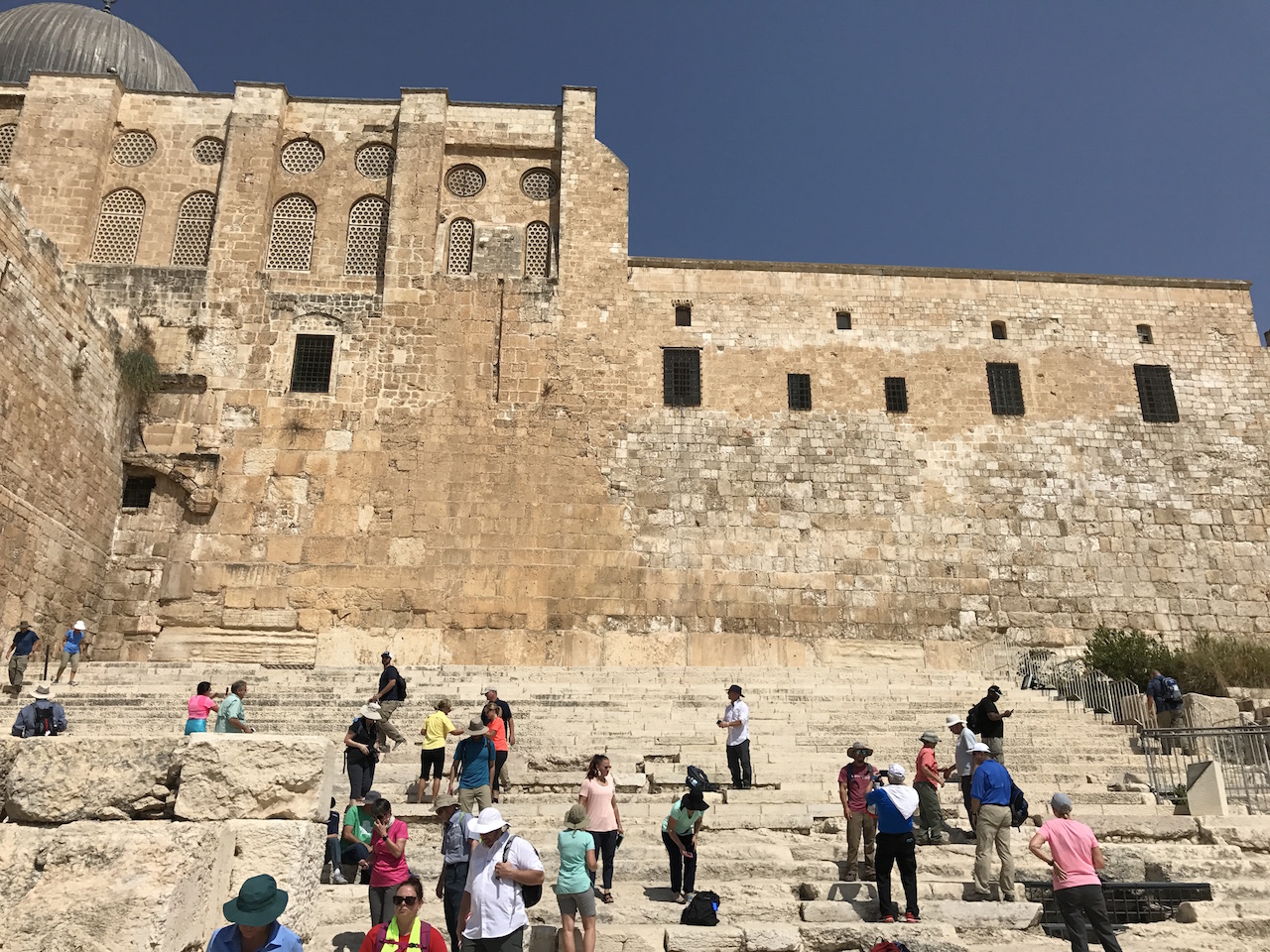
 We also gathered at the steps of the southern end of Temple Mount outside the walls of the city.  These were also known as the “Rabbi Steps” and it is believed that Jesus would frequently teach on these steps right outside the wall of Jerusalem. As Boaz and Andy were teaching, they told us about the places of ceremonial washings or “mikvahs” that we could easily see behind them.  To say there were many mikvahs  would be another understatement.  If we didn’t already have enough chill bumps sitting in that heat on those steps thinking that Jesus taught there, more child bumps were about to form on top of chill bumps again.  In Acts 2 we read that Pentecost happened in Jerusalem.. v5 “Now they were staying in Jerusalem God-fearing Jews from every nation under heaven. …. and each one heard their own language spoken.”  We also read in Acts that sermon Peter preached  and v41 “those who accepted his message were baptized, and about three thousand were added to their number that day.”  Where else could 3,000 people be baptized except in all the mikvahs we were seeing in front of us?  I did not hear the blowing of a violent wind and I did not see tongues of fire, but I can tell you chill bumps formed on top of other chill bumps when I realized what could very well have happened right where we were sitting.